
You saw a screenshot. Here is what is behind it.
A profit picture on Instagram or Telegram is the start of a story, not the whole of it. This site reads the public pages of cTrader Copy and of the Securities and Exchange Commission of Nigeria, writes down how copying works, what it costs and what the pages do not say, and dates every reading. Latest reading: 6 November 2026. It does not tell you whether to copy anyone.
Three ways into the subject
1What copying isA screenshot against the machinery behind it: two accounts, one equity ratio and the cases in which a trade is not copied.2What goes in and what comes outThe two minimums, the naira side, and the three fees with caps of 40%, 10% and USD 10 per million.3What the regulator has saidTwo SEC Nigeria notices, dated 19 October 2018 and 14 May 2026, and the plain finding that none is about copy trading.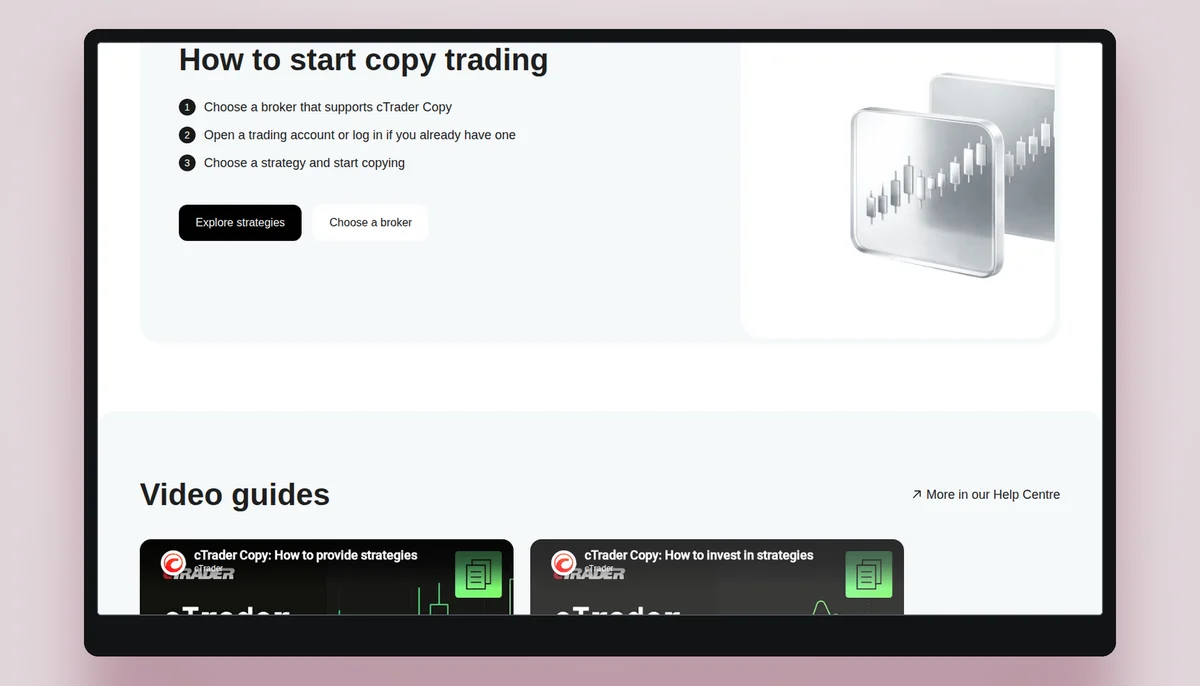
Six pages for the person who has not copied yet
- 01A screenshot against a mechanismTwo accounts, one ratio, and eight cases where a provider's trade does not reach you.
- 02Demo, live and the exitWhat a practice account can copy, the steps to start, the equity stop loss and the steps to stop.
- 03The size of the moneyCard minimums from USD 100 to USD 50,000, broker deposits, and the rule on taking money out.
- 04Naira, dollars and the bankWhat the broker list prints about the naira, the layers of cost, and the questions for the bank and the broker.
- 05Where a copy differsFees, price gaps, and what 20 cards showed about falls in 29 days.
- 06SEC NigeriaTwo public notices quoted with their dates, the register recount and the gap.
Who this page is written for
You saw a screenshot. It was on Instagram, or in a Telegram channel, or forwarded on WhatsApp: a green number, a name, a line about copying. Somebody replied that it worked for them. Now you are on a page that explains what is behind the picture, before you click anything. This site is that page. It is written for a Nigerian reader who has not copied anyone yet and wants to know the machinery, the costs and the limits of what can be known.
It does not tell you to copy, and it does not tell you not to. It reads public pages, writes down what they say, and says where they are silent.
What a screenshot is, and what it is not
A screenshot is a picture of a screen at one moment, chosen by whoever posts it. It does not show the account it came from, the period, whether the money was real or a demonstration, or what happened before and after. The Securities and Exchange Commission of Nigeria addressed the setting in a public notice dated 14 May 2026: it says it noticed the increasing promotion of unregistered online investment schemes on social media applications, naming "WhatsApp, Instagram, Telegram, Facebook, TikTok". The notice is not about copy trading, and this site does not stretch it to be. It is quoted because it describes the setting in which such pictures are posted.
What copying is in four sentences
A provider trades on their own account. A follower puts money into a separate copy-trading account tied to that provider's strategy. The platform repeats the provider's trades there, sized by the ratio of the two equities. The follower can stop at any time, and the fees go to the provider from the follower's account. The rest of this site is detail about those four sentences.
What the platform's front page says it does
cTrader Copy's front page gives four steps: open an account with a broker that supports it, find a strategy, add funds and start copying, and manage risk. The last step lists an equity stop loss, adding or removing funds, and stopping at any time. The same page prints, as headline figures, "800+" strategies and "200+" providers, and carries the sentence that copy trading involves significant risk and may not be suitable for all users. It also states that cTrader Store is not a broker and does not provide investment advice, and that the strategies are provided by third parties.
What this site read, and when
Five public pages of ctrader.com/copy: the front page, the broker list and three symbol pages. Four help pages of help.ctrader.com/ctrader-copy: the overview, investing in strategies, the strategy page and fees. Two public notices of SEC Nigeria and its register of operators. All saved on 6 November 2026 (the register on 5 November 2026), one request at a time, no login. Every figure here is a count or a copy of one of these pages with its date.
The broker list: 24 brokers carry the copy flag
The broker page held 53 entries, and 24 of them carried the copy flag the page prints as "Copy available". Of those 24, 10 print no regulator at all. On the entry for FxPro, the broker this site links to, the list printed a maximum leverage of 1:30, a minimum deposit of USD 100, and the regulators "FCA UK; SCB - SIA Bahamas". 1 of the 24 entries list the naira among their currencies; it is FxPro. That is all this site says about naira accounts.
The 20 strategy cards counted by age, 6 November 2026
The cards on cTrader's gold, bitcoin and euro pages are the same twenty. The table counts them by the number of days between the creation date printed and the day the page was read. No card is named.
| Age on the day read | Cards |
|---|---|
| Under 100 days | 4 |
| 100 to 364 days | 8 |
| A year or more | 8 |
What the twenty cards are
Each card prints a strategy's nickname, name, a return in percent, a minimum investment, a creation date and the symbols traded. This site names none of them. 12 of the 20 are under a year old. Their minimum investments run from USD 100 to USD 50,000, and 6 are USD 100 or less. 15 of the 20 trade gold. 11 list a single symbol; 3 list four or more, up to 10.
A printed return and a short curve on the same card
The printed returns run from -17% to 113,998%, and 8 are 1,000% or more. The pages do not state the period those returns cover, so this site never calls one a result a reader would get. Beside each return the card draws a curve of 29 daily points, from 8 October 2026 to 5 November 2026. 5 of the 20 curves ended below zero, and 4 fell by more than 10 points somewhere along the way. Of the 8 cards that print 1,000% or more, 5 are younger than a year. A big number and a short history can sit together on one card.
What the fees can be
The help page names three fees and prints a cap for each: a performance fee of at most 40% of net profit, a management fee of at most 10% of equity a year, and a volume fee of at most USD 10 per million copied. All are charged to the follower's copy account on the 1st of each month, when copying stops and when funds are removed. The help page's own example, USD 1,000 allocated and USD 700 of profit, gives a performance fee of USD 70 and a management fee of USD 50 a year.
Where a copy can differ from the picture
The platform says provider and investor prices may differ because of trading conditions and execution time. The follower's account is also a different size, started at a different time, charged fees, and, if its leverage is lower than the provider's, may reach stop out earlier. A provider adding or withdrawing money with positions open can cause losses on followers' accounts, according to the help page. None of these has a figure on the pages read, so none has one here.
Practice first, as the pages allow
The help pages say demo accounts deal with virtual funds and can copy only free strategies that the provider allows to be copied by demo accounts. Live accounts can copy any strategy. So a practice account does not always show the strategy you saw. Whether FxPro's practice accounts can follow a strategy is something this site could not find out, and the question is on the list for the broker.
The naira and the bank
All minimums on the strategy cards are in US dollars. Between a naira balance and a copied trade there is at least a conversion, a payment method and the broker's terms, none of which this site read. No page of the Central Bank of Nigeria was read, and no rule of the bank is described here. The page on naira lists the questions to put to the bank and to the broker in writing.
What SEC Nigeria's pages say, and what they do not
This site quotes two notices. The one of 19 October 2018 says "online retail forex trading is currently unregulated and consequently may be subject to abuse". The one of 14 May 2026 advises the public "not to rely on investment advisories circulated through online platforms by persons or entities not registered by the Commission". Neither is about copy trading. This site found no SEC statement on copy trading on the pages it read, and says so as a gap. The register page lists 962 operators; no name in it contains "fxpro", "forex", "copy" or "mirror".
What this site did not do
It did not log in anywhere. A strategy's win rate, drawdown, trade history and fees sit behind the application, and this site read none of them. It opened no account, copied no strategy and measured no fill. It publishes no ranking, no name of a provider, no list of strategies to follow and no return that a reader could expect. A site that did would be advertising, and the reader would carry the risk.
What the strategy list leaves out
The help page says the strategy list only includes strategies whose providers are currently trading. A strategy whose provider stopped is not on it. The cards therefore cannot show how many strategies started and ended, and every count here describes the cards shown on the day they were read. It says nothing about the ones that are gone.
Questions to put to the broker
Is the copy service open to a resident of Nigeria? Which company holds the account, and under what authorisation? Is the account a hedging account, which copying requires? Can a demo account follow a strategy? Which payment methods are taken from Nigeria, at what conversion and with what charge? What is the leverage on the account compared with the provider's? The last answer the help page gives itself: if the provider stops the strategy, all followers stop copying, open positions close and the unrealised fees are charged.
A short glossary
Provider: the trader whose positions are copied. Follower or investor: the account that repeats them. Equity: the balance with open profit and loss included. High-water mark: the highest value reached, above which a performance fee is charged. Leverage: the multiple by which a position is larger than the margin put up for it. Stop out: the broker closing positions because the margin is no longer enough. Contract for difference: a contract on a price, not ownership of the thing priced.
How a figure on this site is checked
The pages are saved as read. A second script recounts the brokers, the cards, their returns, minimums and dates, and the largest fall inside each curve from the saved files by a different route, and compares. Five defects planted on purpose, one in each of five places, were each caught. That checks the copying of numbers. It does not check that the platform's pages are right.
The broker this site links to
This site links to FxPro, which cTrader's list marks as a copy-enabled broker. A copied trade is a leveraged contract on a price, not ownership of anything. Read the terms before you decide anything.