
From a profit screenshot to a copied trade
A screenshot shows a number a person chose to show. Copy trading is a machine that repeats that person's trades on your account, in proportion to your balance. This page separates the two and follows the cTrader Copy help pages, read on 6 November 2026. It does not say whether to copy anyone.
The picture and the machinery
A profit screenshot is a still image of a screen at one moment. It does not show how the number came about, what was open at that moment, what was lost earlier or what happened afterwards. Copy trading is something else: software that watches one account, the provider's, and places matching trades on another account, the follower's. The screenshot is what brings a person to the service, but a screenshot is a message and a copy is a mechanism.
In a signal group, a person reads a message and places the trade by hand. In copy trading nobody places the trade by hand: the platform does it, and it keeps doing it until the follower stops it. That difference is the reason for the questions on the other pages of this site.
Four words the help pages define
The overview page of cTrader Copy defines its terms in a short list. The right column gives the page's meaning in shortened form. Source: help.ctrader.com/ctrader-copy (overview), read on 6 November 2026.
| Word | What the help page means by it |
|---|---|
| Strategy | The set of all trading actions a provider executes on their live trading account, offered to others for copying under set conditions. |
| Strategy provider | A trader who shares a strategy for copying and earns investor fees. |
| Investor | A cTrader user who allocates funds to copy a strategy under its conditions. This site calls the same person the follower. |
| Copy-trading account | A separate account, created from the funds the investor allocated, used only for copying that one strategy. |
One formula decides the size
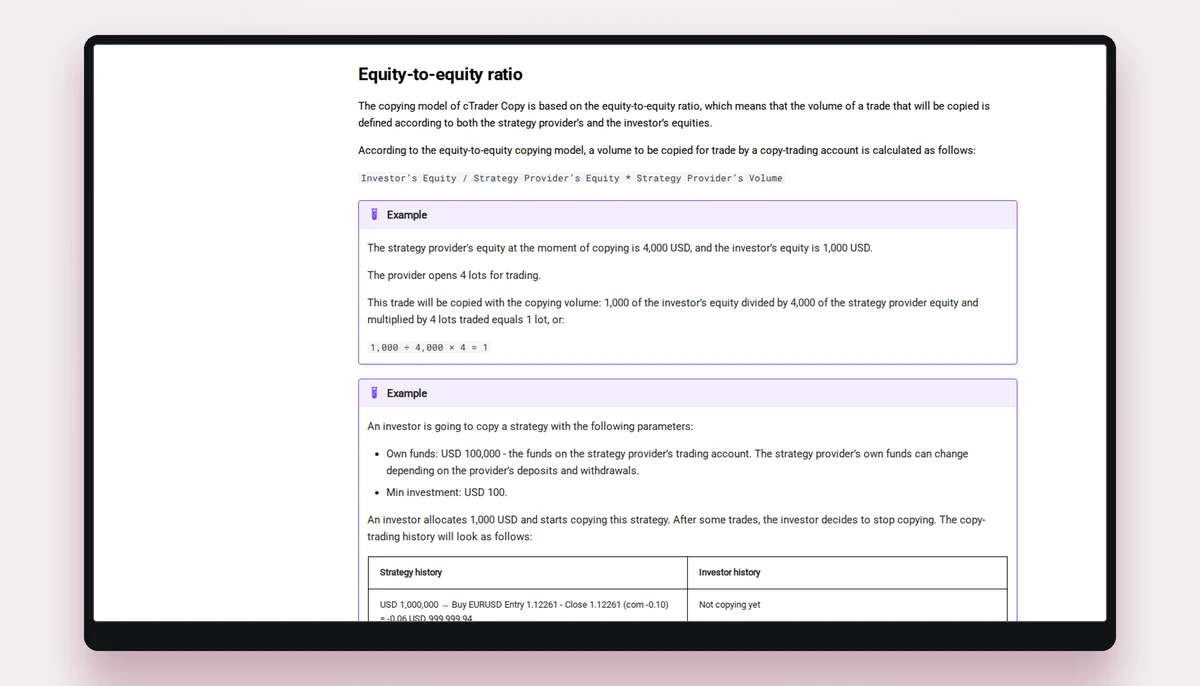
The help page states the rule in one line: the volume copied is the investor's equity divided by the strategy provider's equity, multiplied by the provider's volume. Equity here is the account balance with open profit and loss included. Its worked example has a provider with USD 4,000 and an investor with USD 1,000. The provider opens 4 lots; 1,000 divided by 4,000, times 4, is 1 lot, and that is what the investor's account opens.
The page adds that deposits and withdrawals on either side are taken into account, so the sizes stay relative to what each party has put in. A follower with a quarter of the provider's money holds a quarter of the provider's position size; the result is a share of the provider's trades, not a copy of the provider's amount.
When a provider's trade does not reach the follower
The overview page lists the cases in which the copying mechanism does not repeat a trade, or repeats it in a changed form. Each row is one case in the page's own terms. Source: help.ctrader.com/ctrader-copy (overview), read on 6 November 2026.
| Case | What the page says happens |
|---|---|
| Not enough funds in the follower's account | The provider's trade is not copied. |
| The follower's broker lacks the instrument | The provider's trade is not copied. |
| The follower's leverage is lower than the provider's | Free margin may not be enough to copy all trades; the trade may not be copied. |
| The calculated volume is below the broker's minimum | The size is adjusted to the step the broker allows. |
| The calculated volume is above the broker's maximum ticket | No position is opened. |
| The market for the symbol is closed | The position is opened only when the market opens. |
| The symbol represents a stock or share (the page names AAPL and TSLA) | The provider may trade it; followers' accounts do not copy it. |
| The follower's account is a netting account | Copying is not supported; only hedging accounts can copy. |
What the follower hands over, and what stays
The follower hands over the decision of what to trade and when. The follower's money, the copy-trading account, the margin and the loss on it all stay on the follower's side. The platform's front page says the same thing from its own side: copy trading involves significant risk, cTrader Store is not a broker and does not provide investment advice, and the strategies are provided by third parties.
A copied trade is a leveraged contract on a price. The follower does not own the thing the price belongs to.
What a screenshot cannot be checked against
The help pages list what a strategy page shows: the account type, the strategy's age, an all-time return, an equity chart and a return chart, and, under a summary heading, figures such as maximum balance drawdown and percent profitable. A screenshot of one of these shows at most one of them, and a reader looking at the picture cannot tell which period, which account type or which strategy it belongs to unless the picture says so. This site cannot say what any particular screenshot shows. It can say what the strategy page defines, so a reader has the list of things to ask the person who posted it.
In brief
Read next
Beginner questions, answered from the pages
Is copy trading the same as a signal group?
No. In a signal group the reader places the trade; in copy trading the platform repeats the provider's trades on the follower's account.
Does the follower copy the provider's amounts?
No. The size follows the ratio of the follower's equity to the provider's equity.
Is every provider trade copied?
No. The overview page lists cases in which a trade is not copied or is adjusted, including a ban on copying trades in stocks and shares.
Can this site say if a screenshot is real?
No. It reads the platform's public pages and has no access to any person's account.
The broker this site links to
This site links to FxPro, which cTrader's list marks as a copy-enabled broker. A copied trade is a leveraged contract on a price, not ownership of anything. Read the terms before you decide anything.